


A Brief History of Both Skate Styles
Roller skating has a surprisingly long history. The first recorded use of roller skates dates back to 1743, when they appeared on a London stage. However, the modern four-wheeled quad skate wasn't patented until 1863 by James Leonard Plimpton. His design placed two wheels on each side of the foot, creating a stable, maneuverable ride that quickly became popular in skating rinks across the United States and Europe.
Inline skates came much later. While early inline prototypes existed in the 1800s, the modern version wasn't popularized until the 1980s when Scott and Brennan Olson, two hockey players from Minnesota, redesigned the concept for off-season training. Their version, eventually sold under the brand name Rollerblade, exploded in popularity throughout the late 1980s and 1990s. The term "rollerblading" became so widespread that many people still use it interchangeably with inline skating today.
Understanding where these two types of roller skates came from helps explain why they look and perform so differently. Their origins reflect very different purposes, and those purposes continue to shape how skaters use them today.
Key Differences in Design and Structure
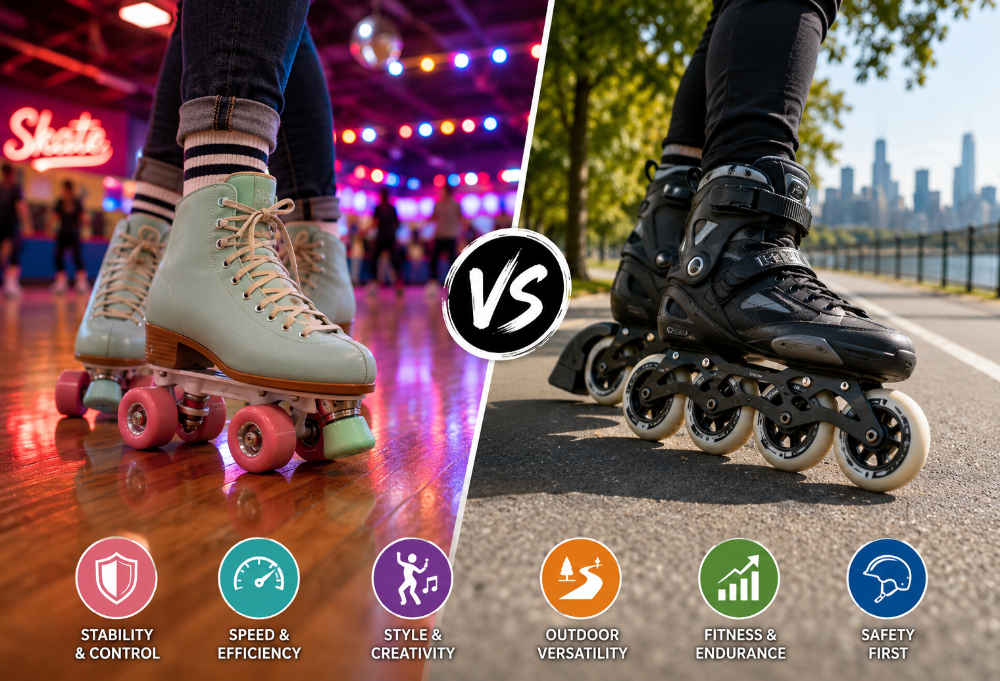
The most obvious difference between quad skates vs inline skates comes down to how the wheels are arranged. Quad skates feature four wheels set in a two-by-two configuration beneath the boot, much like a car. This layout creates a wide, stable base that makes it easier to balance when standing still or moving at slower speeds. The boot itself is typically low-cut or high-cut depending on the style, and most quad skates come with a toe stop at the front, which is used for braking.
Inline skates, on the other hand, have three to five wheels arranged in a single straight line beneath the boot, similar to an ice skate. This narrow wheelbase requires more ankle strength and balance but allows for faster speeds and a more natural stride. Instead of a toe stop, most inline skates feature a heel brake attached to the rear of one skate, though advanced skaters often remove the brake altogether as their skills improve.
The boot construction also differs significantly. Quad skate boots often resemble sneakers or shoes and may feel more comfortable right out of the box. Inline skate boots are usually more form-fitting and technical, constructed from harder materials that provide support during high-speed skating or aggressive maneuvers.
Performance and Use Cases: Which Skate Fits Your Style?
When comparing quad skates vs inline skates in terms of performance, there is no universal winner. It all depends on what you want to do with them.
Quad skates shine in rink skating, rhythm skating, and artistic skating. Their wide wheelbase makes them ideal for smooth indoor surfaces where style and footwork take center stage. Roller derby athletes overwhelmingly prefer quad skates because of the lateral control they provide, which is critical when jostling for position in a tight pack. Dance skaters and jam skaters also gravitate toward quads because they allow for quick spins, toe work, and stylized movements that feel natural on four stable wheels.
Inline skates tend to dominate when it comes to speed, distance, and outdoor terrain. Speed skaters almost exclusively use inline skates due to the efficiency of the wheel configuration and the lower profile of the boot. Fitness skaters who log miles on bike paths and sidewalks typically prefer inline skates because they glide more smoothly over uneven pavement and allow for a longer, more powerful stride. Hockey players also rely on inline skates for off-ice training, since the movement pattern closely mimics what they do on ice.
Aggressive inline skating, which involves grinding rails, jumping gaps, and performing tricks in skate parks, is another discipline built almost entirely around inline skates. Specialized aggressive skates have smaller, harder wheels and reinforced frames designed to absorb the impact of high-flying maneuvers.
That said, outdoor quad skating has made a massive cultural comeback in recent years, driven in large part by social media. Skaters have taken to urban environments, outdoor plazas, and beach boardwalks on quad skates, and the community around it has grown into a full-fledged lifestyle movement.
Learning Curve: Which Is Easier for Beginners?
This is one of the most common questions in the quad skates vs inline skates conversation, and the answer is more nuanced than most people expect.
Many skating instructors and experienced skaters argue that quad skates are easier for absolute beginners. The wider wheelbase provides more immediate stability, making it less intimidating to take those first few strides. Standing still on quad skates feels more natural for most people, and the toe stop offers an intuitive braking method that is easier to learn than heel braking.
However, some people find that inline skates actually suit them better from the start, particularly those who have ice skating or hockey experience. Since the wheel layout mimics an ice blade, the muscle memory translates well. The heel brake on inline skates, once learned, can also be quite effective for slowing down safely.
The truth is that both types of roller skates require time and practice. Falls are part of the process regardless of which style you choose. The most important factor for beginners is not which skate is technically easier, but which one aligns with the type of skating they want to do. Buying quad skates when you really want to skate outdoors for fitness, or buying inline skates when your goal is to hit the rink on weekends, will only slow your progress and reduce your enjoyment.
Protective gear is non-negotiable for beginners on either type of skate. Wrist guards, knee pads, and a helmet can prevent serious injuries and give you the confidence to push yourself further without fear.
Cost, Maintenance, and Longevity
Price varies widely across both categories depending on brand, materials, and intended use. Entry-level quad skates can be found for as little as $40 to $60, though skates in that range are often made with cheaper materials that wear out quickly. A solid beginner-to-intermediate quad skate typically falls in the $80 to $150 range. High-performance quad skates used by derby athletes or artistic skaters can climb into the hundreds or even thousands of dollars.
Inline skates follow a similar pricing structure. Budget models start around $50, while quality fitness inline skates for regular outdoor use generally run between $100 and $200. Competitive speed skates and high-end aggressive inline skates can cost several hundred dollars or more.
Maintenance is an important part of ownership for both types of roller skates. Bearings should be cleaned and lubricated regularly, especially if you skate outdoors where dirt and moisture can cause them to degrade faster. Wheels wear down over time and need to be rotated or replaced depending on usage. Boot liners may need replacing after years of heavy use, particularly in inline skates where the liner takes on a lot of impact.
With proper care, both quad and inline skates can last for many years, making either type a worthwhile long-term investment.
Conclusion
The choice between quad skates vs inline skates ultimately comes down to your goals, your skating environment, and your personal preference. Quad skates offer stability, style, and a strong community rooted in rink culture and roller derby. Inline skates provide speed, efficiency, and versatility across a wide range of outdoor and competitive disciplines. Both represent legitimate and rewarding ways to enjoy one of the most timeless recreational activities around. Try both if you get the chance, and let your skating goals lead the way.